Sunday, March 15, 2015

I can do it myself.


Never help a child with a task at 
which he feels he can succeed.
-Maria Montessori


One of our major goals is to help build self-confidence in the children and provide time for them to practice important life skills. 

Here are just a few of the daily routines, where the children have a chance to gain independence.


Getting dressed

The children are reminded and encouraged to do as much of their own dressing and undressing for outdoor play as possible. We give reminders to the children to guide them to remove their own shoes and jackets. Sometimes they need help with the velcro, laces or zippers, but then they can actually remove the item and put it away themselves. When getting ready to go outside, they are asked to put on as much as they can and then approach us to be zipped, buttoned, tucked etc. Often we will hook their zipper and have them pull it up themselves.


.


Toileting

In the bathroom children are encouraged to be as independent as possible. If the child is still in pull ups (or diapers), they are expected to pull everything down and then back up after they have been changed. These are the beginning steps to helping themselves in the bathroom. In order for children to feel successful they need to have stretchy clothing on. Things that discourage independence in the bathroom: tight fitting pants, buttons, snaps, belts and overalls. These can also be a problem if a child is rushing to the bathroom in an emergency and can’t get onto the potty in time.


At the table.

Children pour their own water and pass the water pitcher to their friends. They ask to “clear” or to be excused when they are finished. They sometimes have to make two trips to the kitchen, but they scrape their plates and put them in the sink. As the year goes on children are provided with more opportunity to serve themselves. We have recently started experimenting with occasional buffet style meals.


Outside

There are lots of different experiences for the children on the playgrounds. Some of the elements are simple and some requires a bit more balance and physical ability. The general rule at Inch By Inch is once they can safely get on and off by themselves, than they are ready to use it. If a child climbs onto something and needs assistance to get back down, than they are redirected to something easier that can strengthen those same skills. Teachers act more as observers on the playground, allowing the children the time and space to explore and problem solve on their own.


I think that being in a social environment is a great place for children to practice these skills. There is often more time for practice at preschool than there is at home. The children are usually more willing to try for another adult besides their parents. And of course, most importantly, they are learning from and watching each other succeed. Self-motivation is the best motivation.



Friday, February 27, 2015

Welcome to Our Preschool


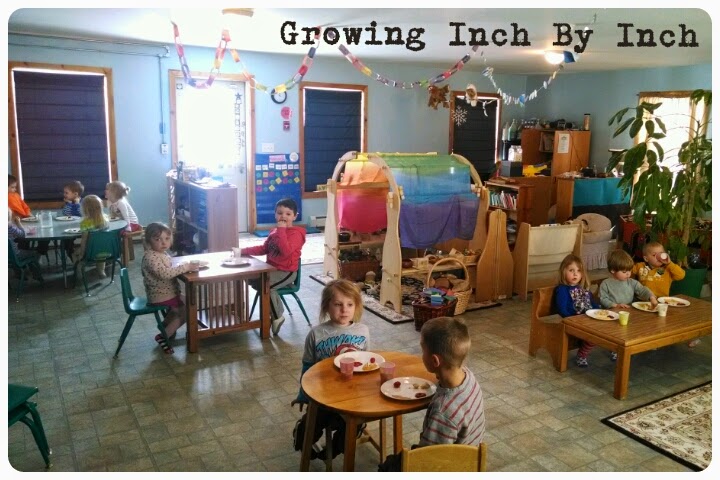
We are fortunate to have such a big space for our small group of twelve children. We have divided the classroom into several areas to encourage different types of play. You can read more about the system we use in the classroom here "Making Choices: Where are you playing?"


I thought I would give a tour of the different play spaces in the classroom.


Imagination Station:

Imagination Station is a new area we created from combing our dress up and block area. It currently has  baby dolls, Fafu dress up clothes, wooden play food and table on one side and blocks, tubes, loose parts, small cars, people, and occasionally ride-on cars.  There are two different floor surfaces and it is common for the children to dress up on the "home side" and travel to work, camping or the ocean on the other side.


The Art Table: 
There are always open ended art materials available for the children to explore on their own. We paint, cut, glue, color, collage and use playdough.


Small World Play: 
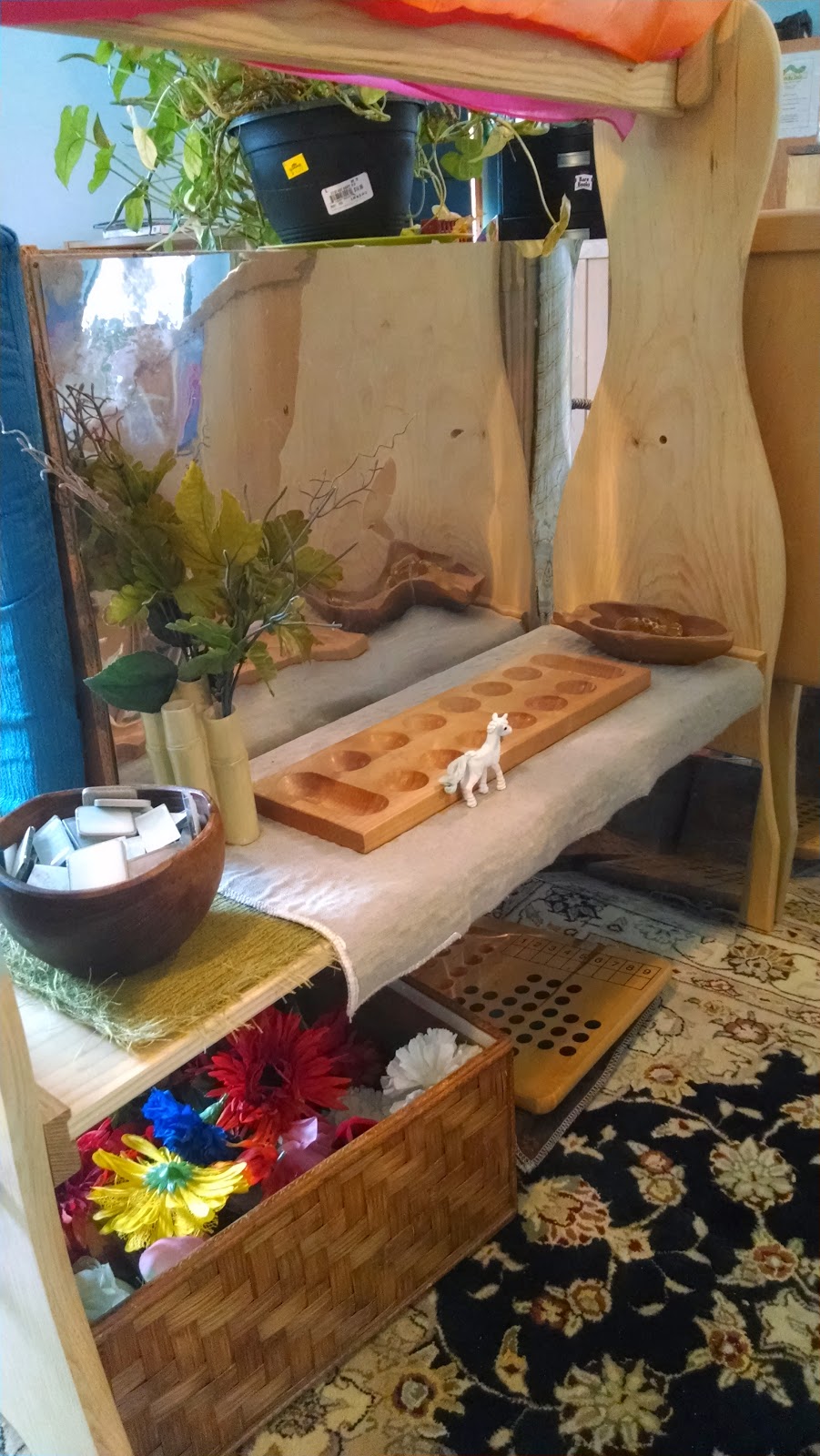
This a cozy area where children have access to loose parts, natural materials and small dolls or animals to create worlds and use their imaginations. 


Quiet Reading Area: 
This is a space that is limited to one or two children. A quiet nook with books, blankets, pillows and a small place to "escape"  to


Octagon Table: 
A large table that is used for standing activities such as trains, lego, small building blocks or other manipulatives.


Sensory Table: 
I have recently heard another educator refer to it as the "touch table." I love that. The contents of this table usually shifts every week or two, depending on how long the children stay interested. Sometimes we put the cover on it and use the surface for other activities.


Gathering Rug: 
Is our place to have meetings and circle time. It is also a place where the children know they can go to get out some extra energy. There is always some sort of big muscle supplies (bean bags for throwing, weights for lifting, carpet squares for hopping on.)


Here is a blog post about it what one day looked like on the Gathering Rug: Balancing Act.


Hope you enjoyed the tour! Our classroom is forever evolving and moving to meet the needs of the children throughout the year and from group to group. 


Monday, February 16, 2015

Masking Tape Art


Every year I volunteer to set up a table at a local children's festival put on by the Children's Task Force. This festival is over two decades old and I remember attending as a child. 


Local organizations and businesses set up tables with hands on activities for children. The first few years I did paper bag puppets, pasta necklaces and things like that. I found there were often duplicates of my activities around the room. 

Several years ago I started bringing colored masking tape and black cardstock. This is such a hit every year now. 


 I am always amazed by the different ages that participate and the amazing creativity that I see.  The last couple years I have also added stickers for the smaller toddlers.


Some children sit and stick two pieces of tape and are ready to move on (there is a lot of things to do).

Some children stay at the table for A LONG time working on one picture or sometimes making several (if their parents allow them the time).

Some children come back later in the day to make a new picture (or to add details to their original).


The children use this open ended material in so many different ways that reflect their age and creative styles. For the first time this year a child (4 years old) cut up his paper and taped it back together into an animal. "Naturally" if you have tape, you must need something to tape together. 


Other creative styles I see:

Concrete images
Abstract Designs
Initials and Names
Rainbows
Patterns
Frames
Smoothed out tape
Crumpled table (intentional and not)


Kids love tape. The End.


** I purchase the tape from Discount School Supply. I prefer the 3/4" size. 


Friday, February 13, 2015

Learning From Garden to Table


I am excited to feature my first guest post on Growing Inch By Inch. 
I would like to welcome Tammy from Today's Play. 
We first connected through a Facebook group and the way she involves the children in mealtimes continues to be an inspiration to me. Here she shares photos of her home-based childcare and their experiences with gardening and mealtimes.


“Not having heard something is not as good as having heard it; having heard it is not as good as having seen it; having seen it is not as good as knowing it; knowing it is not as good as putting it into practice.” ~ Xunzi 


What do you remember from being in school when you were a child? Are there certain memories that stand out more than others? I remember the parts of school that I enjoyed, mainly recess and playing with my friends and just a handful of classroom activities that have always stayed with me. The first memory is from kindergarten when my teacher told us the story, The Little House with No Doors and No Windows and a Star Inside. She cut open an apple for us all to see the little star inside and I remember feeling inspired. The second memory that has stayed with me was in first grade when we were learning about Switzerland and my teacher brought in her fondu pot and we got to eat cheese fondu and I remember feeling trusted. My third memory was in second grade when we made butter by shaking little jars full of cream. I remember feeling involved.

Funny how all my vivid memories involved food but I think food can be one of the greatest resources for learning during childhood. 

I was fortunate to grow up with influences of farm life, gardening, raising chickens, canning, and lots of good cooking. Not all children get these experiences and even though it is obvious to us, adults, where food comes from and how it is prepared, it’s not obvious to a toddler or preschooler, if they have never been exposed to it. 


Gardening with children is simple, inexpensive, and extremely rewarding. My grandmother had a huge garden that she tended to into her nineties. I was fortunate to have that experience but a large garden with rows and rows of crops isn’t necessary for children to benefit from it. There are so many alternatives, even for those with limited space. We live in an urban suburban area so we have to squeeze in our gardening where we can. There are so many vegetables that are easy to grow and take up very little space or you can even try to fit corn in your garden like we did one year. 


Growing food with children is a wonderful learning experience and so is composting. The task of dumping the food scraps into the compost bin, is a favorite here. It’s really great to be able to show children the whole cycle of growing and decomposing and if you’re lucky, you might find something fun growing in your garden from your compost soil, like we did when gourds came up one summer. 


We love to cook and do about two to three cooking projects each week, sometimes more. Food prep is an easy way to get children involved. Children love to snap green beans, shuck corn, peel cucumbers, grate cheese, and chop vegetables. Cutting herbs is a great way for little hands to practice using scissors. We usually do a little sampling of the foods while we’re prepping. It’s a wonderful way to get children to eat vegetables or try new foods.


Cooking is a perfect opportunity to introduce children to various tools, vintage as well as modern. Using different kitchen tools is great for developing motor skills and getting a hands-on experience with how things work. Being part of the food prep and cooking process is filled with learning opportunities just as the meal itself is. Each day, a child sets the table for lunch which builds multiple skills such as math, specifically one to one correspondence, sequencing, positional understanding, and of course, a sense of pride. We have family style meals where the children serve themselves food and pour their own milk. 


Children are given the responsibility to choose which foods they would like to eat and the amount that is appropriate to serve oneself. Our meals become a very social time that are respectful to the children but also a time when children can be a little silly with each other. Over the years, I have seen different groups of children come up with various meal time “games” that are continuous and evolving. It is a peaceful engaging time and no child is ever rushed nor is a child ever expected to wait while the other children finish their meal. In addition to our family style meals, we sometimes have special meals when children have even more opportunity to make choices and take part in preparing their own food.


 And sometimes, the things we adults like the least are the things children like the best. Ending the meal with children washing their own dishes provides a wonderful sensory experience, a time to enhance motor skills, and again, a sense of ownership and pride. 


For more mealtime inspiration ... Dining Inspirations

Friday, January 30, 2015

Sometimes I Just Ignore the Children.


Confession #1: Sometimes I just ignore the children.


Confession #2 : I am not actually ignoring them. 
They just think I am (if they even notice at all).


I think outdoor play at preschool is such an important time for children to be "away" from adults. If I look busy to them, than they figure it out. They do their OWN thing. Work out their OWN problems. Use their OWN words with each other. They don't shy away from their imagination because they don't like the spotlight of an adult's attention.  This goes back to my post from a couple weeks ago about "Letting the Wander." 


The illusion of being away from us.


I often wonder when people drive by the preschool and I am off on my own shoveling snow or moving rocks if people think I am not paying attention to the children. I assure you that I am fully aware of the games they are playing and I'm usually trying to create some sort of invitation to add to their play.

Today was one of those days. There was a small crowd and they were playing happily on our GIANT snow mountain (made by the plow truck). They were playing ninjas and I thought that ninjas probably need places to hide. 

Without them really paying much attention to me or me to them, I started digging holes. It was a great way for me to get in some exercise too, while they were busy playing. *Local readers are probably thinking I'm crazy for doing extra shoveling this week just for fun.

 The holes quickly became very popular. As they started to "take over" the hideout I was digging, I would just move to a new space and dig another slightly different one.  Before I knew it the game had changed. Everybody was part of the ONE game, even from their separate hideouts. *I won't bother to try and explain the game, as it is most likely too complicated for adults to understand. Something about teams and ninjas and the leader of the just-born team members. 


Photo Op.

At the end of play time, each of the children ran to hide in one of the holes, to see how truly hidden they could be from the parking lot.


Where did the children go? 

Popping out of their hideouts when I called their name.


Please visit the Outdoor Play Party to see how others have been playing outdoors lately!